Gods & the world · 7 min read
Thor Dresses as a Bride
Þrymskviða
Tap an underlined name for a short explanation.
woke and reached for his hammer. It was gone. His beard shook, his hair bristled, and he felt around him as though the weapon might still be close enough to recover by touch. Then he told what no one on earth or in the upper heavens yet knew: the god had been robbed of . Without it, the defender of had lost the weapon on which the gods’ security depended.
They went to and asked to borrow her feather-garment. She would lend it even if it were made of gold, she said, and give it even if it were silver. put it on and flew out of the gods’ enclosure toward the land of the giants. The feathers sounded as he crossed the distance. Below, sat on a mound, twisting gold collars for his dogs and tending the manes of his horses, at ease in the wealth of his own domain.
asked what was happening among the gods and elves, and why had come alone. Things were going badly, answered. Had he hidden ’s hammer? The giant admitted it without hesitation. lay eight leagues beneath the earth. No one would recover it unless were brought to him as his wife. He had found a price that the gods could neither ignore nor readily pay.
flew back. wanted the report before its telling could be delayed: news might be forgotten by a seated man, he said, or altered by one who lay down. repeated the demand. Together they went to and told her to put on a bridal veil; they were going to drive to the giants’ country. They spoke as though the decision had already been made.
’s anger shook the hall. She snorted with such force that the great necklace sprang from her. What would people call her if she travelled to on that errand? Her answer ended the proposed exchange. The gods now had to recover their protection without handing over the woman whom the thief had demanded.
Reið varð þá
ok fnasaði,
allr ása salr
undir bifðisk,grew angry and snorted; the whole hall of the gods trembled beneath her.
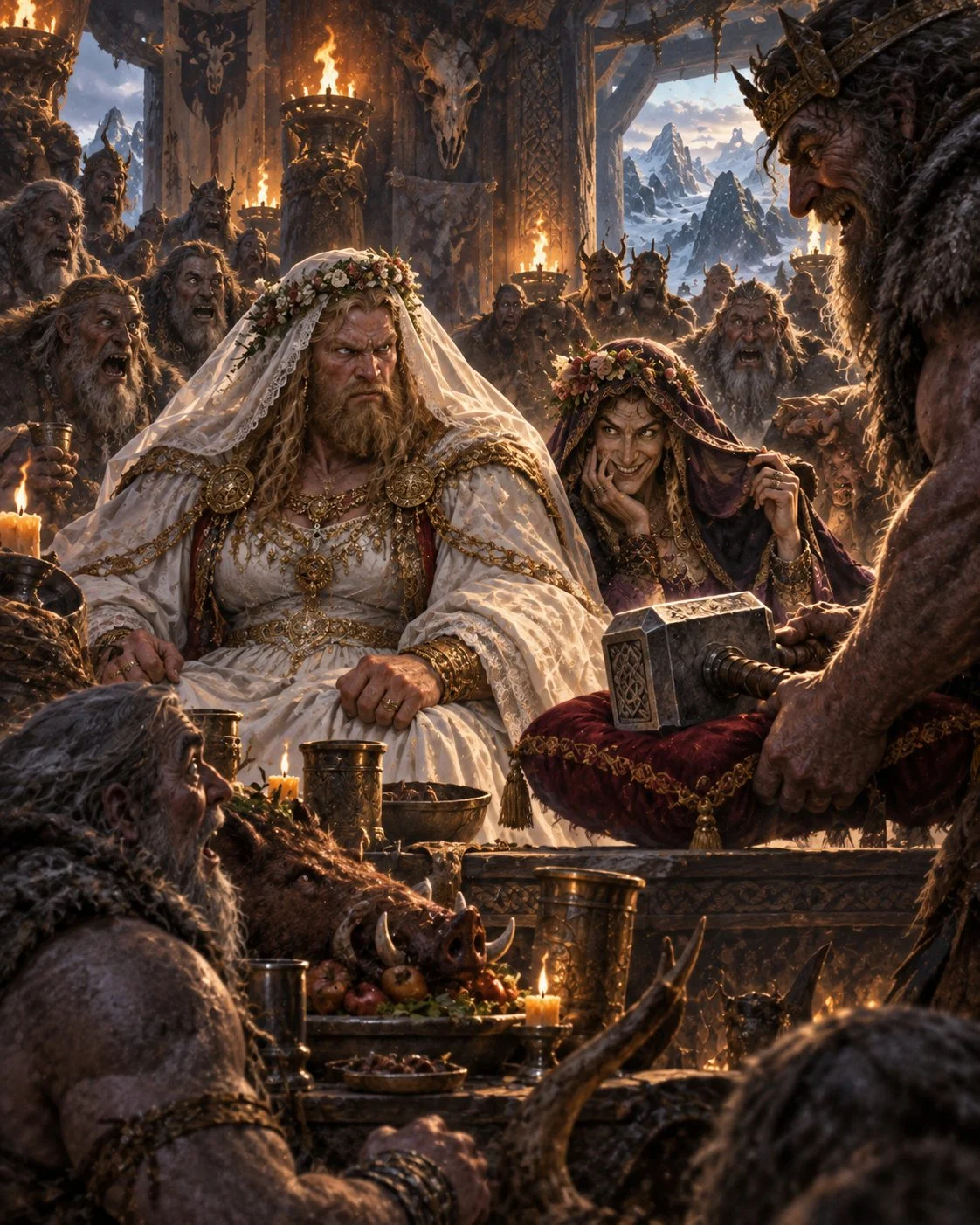
They assembled to consider what could be done. , whose foresight the poem praises, proposed that should become the bride. They would dress him in bridal linen, hang ’s necklace around him, place keys at his waist, let women’s clothing fall about his knees, and arrange ornaments on his breast and head. The plan was detailed because every visible sign had to support an identity that the wearer’s body and temper would continually threaten to betray.
protested that the gods would call him unmanly. told him to stop talking that way: the giants would soon inhabit unless he recovered his hammer. The danger overcame his objection. They dressed him exactly as had proposed. volunteered to go as the bride’s maidservant. The pair who had failed to persuade would now carry out the journey in the roles of two women.
The goats were harnessed and driven hard. Mountains broke, the earth burned, and ’s son travelled to the giants beneath his bridal coverings. ordered the benches prepared. , ’s daughter from , was being brought to him at last. He had gold-horned cattle, black oxen, treasure, and necklaces in abundance; only had been missing from the catalogue of things he desired.
That evening the feast began. The bride ate an entire ox, eight salmon, and all the delicacies intended for the women. She drank three large measures of mead. stared. Where had anyone seen a bride with such an appetite or a maiden drink so much? The disguise was in danger almost as soon as the company sat down, because ’s hunger had survived the change of clothes.
The clever maidservant had an answer ready. had eaten nothing for eight nights, so eager had she been to come to . accepted the explanation his own desire made welcome. He leaned beneath the veil to kiss her—and sprang back the length of the hall. Why were ’s eyes so terrifying? Fire seemed to burn from them.
Again converted a warning into proof of love. She had not slept for eight nights, he explained, because she longed so much for the journey. The giant’s imagined bride was starved and sleepless with desire for him. The real bride was a furious god waiting to get his hands on a weapon. Between those two interpretations stood the maidservant, supplying the precise words needed to keep the feast moving.
’s sister came forward and asked for the red-gold rings on the bride’s hands. If the newcomer wished to gain her love and goodwill, she should make the gift. The poem holds that request until its violent answer can arrive. Around , the giant family were already treating the marriage as a settled fact and beginning to distribute the benefits they expected from it.
At last ordered the hammer brought in to consecrate the bride. was to be laid in her lap, and the marriage sanctified under ’s hand. What had been hidden deep underground was carried into the hall for a ceremony. The giant himself gave the instruction that put the stolen weapon within its owner’s reach.
Berið inn hamar
brúði at vígja,
lekkið Mjöllni
í meyjar kné,Bring in the hammer to consecrate the bride; lay in the maiden’s lap.
’s heart laughed when he recognised it. He killed first, then struck down the giant’s household. The sister who had asked for rings received hammer blows instead of bridal wealth. The poem’s comedy ends in the sudden violence that every earlier interruption has postponed. There is no extended pursuit or final contest: the decisive change is simply that is once again in ’s hand.
So ’s son recovered his hammer. ’s refusal, ’s scheme, ’s endurance of the disguise, and ’s quick answers all contributed to the victory. saw what he wanted to see until the last possible moment. The appetite, blazing eyes, and astonishing journey had warned him, but each warning had been translated into the story of a bride desperate to become his wife.
About this retelling
The narrative follows Þrymskviða’s complete sequence, including Freyja’s refusal, Heimdallr’s proposal, and Loki’s explanations at the feast. The bride’s hammer ceremony is described as the poem presents it, without claiming it documents every historical Norse wedding.
The Old Norse follows a normalized edition, rather than the manuscript’s exact spelling. The English beneath each quotation is a new rendering for this reader. Stanza numbers follow the linked Norse text.
Mythological poem 9 · 1,030 English words · Reading time at 170 words per minute