Gods & the world · 7 min read
Loki’s Quarrel at Ægir’s Feast
Lokasenna
Tap an underlined name for a short explanation.
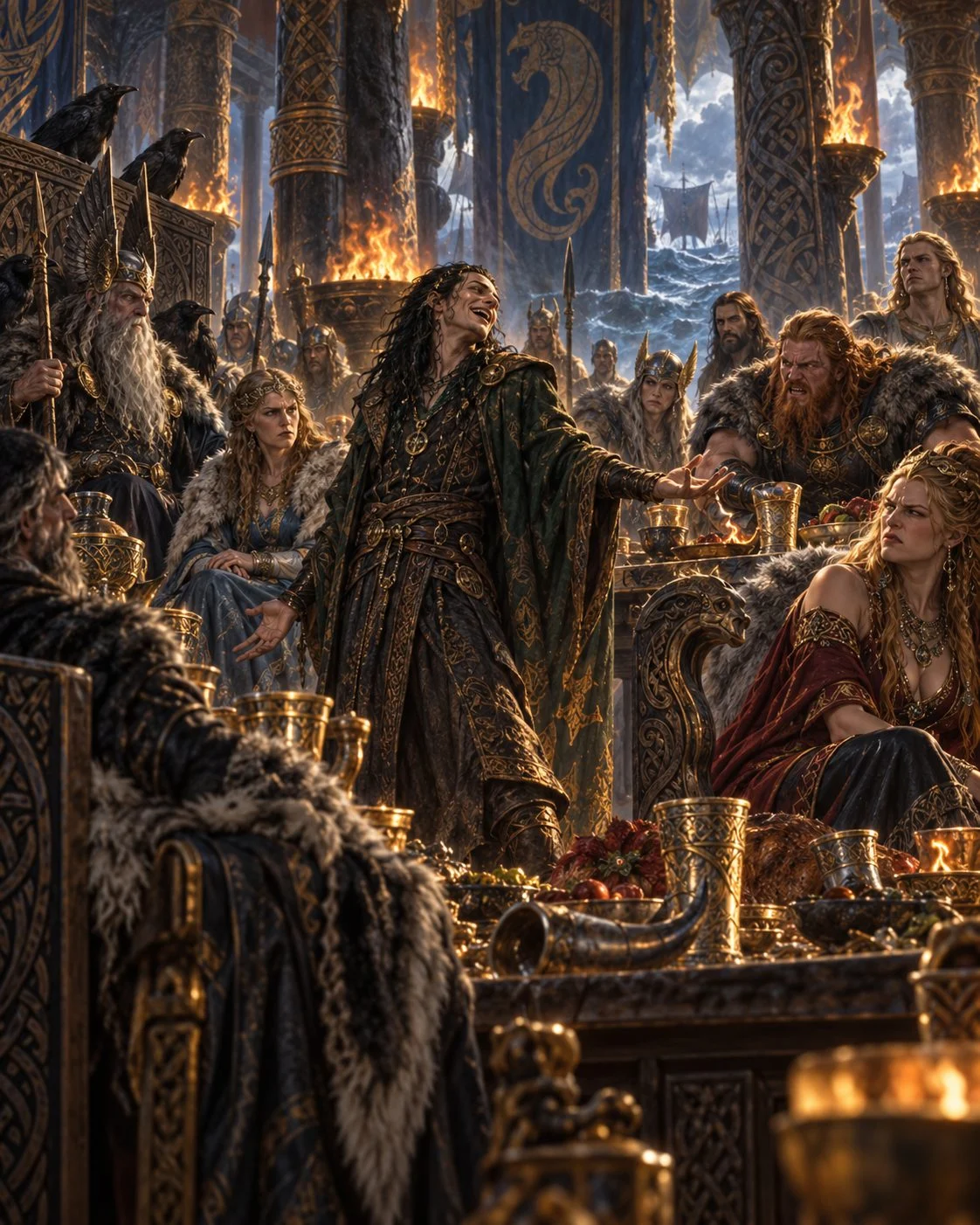
’s hall shone with gold instead of firelight. The great cauldron had been obtained, the ale was ready, and the gods and elves had gathered for a feast. was away in the east, but and were present, along with the other divine guests. The servants and attended them so well that everyone praised their skill. could not endure the praise. He killed , and the gods drove him out.
He returned to the edge of the hall and questioned . What were they talking about inside? Their weapons and their courage, answered; neither gods nor elves had a friendly word for . That was no deterrent. announced that he meant to mix malice into their mead. warned that the company might wipe the insults back onto him, but was confident in the supply of words at his disposal.
When he entered, conversation stopped. demanded a drink and a place to sit, or an explicit order to leave. said the gods would give him neither seat nor welcome. Then appealed over ’s head to an older bond: he and had once mingled their blood, and had promised never to accept ale unless it was offered to both. Whatever the gathering now thought of him, that obligation remained available for him to invoke.
Mantu þat, ,
er vit í árdaga
blendum blóði saman?Do you remember, , how in the earliest days we mingled our blood?
told to make room and serve the wolf’s father. Once seated, greeted all the gods and goddesses except . The excluded god offered a horse, a sword, and a ring if would refrain from sowing hatred. called him a coward whose courage extended only to his bench. threatened to take his head if they were outside the hall. invited him to prove it. Every attempt to quiet the visitor gave him another opening.
intervened to calm her husband and prevent bloodshed. accused her of embracing her brother’s killer. protested against the quarrel and was accused of sexual favours in return for a necklace. The poem supplies no independent scene verifying these stories. We hear them in an adversarial performance, where ’s aim is to make restraint look like weakness and any claim to honour seem vulnerable.
defended ’s knowledge of fate. changed the subject to ’s conduct in war: had he not repeatedly given victory to men who did not deserve it? answered with a taunt about having lived as a woman and borne children. retaliated by naming ’s practice of , magic associated here with a degrading violation of masculine expectations. Their insults depend on the prejudices of the speakers’ world; the poem gives neither god a position outside the accusations.
asked them to leave their old deeds unspoken. replied with another sexual charge, this time against her. said that if a son like were beside her, would not leave without a fight. He struck directly at her grief: he was responsible for her never again seeing ride home. For a moment the repeated pattern of scandal became something colder. The bereaved mother had named the son whose death could use against her.
reproached him for revealing his own wickedness. He accused her of taking all the gods and elves as lovers, then added an obscene story involving her brother. refused to treat a woman’s lovers as the disaster implied, but answered with his own insult about bearing children. attacked ’s history as a hostage among the gods and the kinship of ’s parents. Each reply drew more of the divine household into the dispute.
praised as a generous and honourable god. pointed to ’s missing hand, bitten off by when the wolf was bound. replied that both of them had suffered a loss: he lacked his hand, while lacked his imprisoned son. threatened with bonds of his own. answered that had bought ’s daughter with gold and given away his sword, leaving himself without it when the sons of came riding. An old bargain was turned into a prediction of vulnerability at the world’s end.
’s servant wished he had his master’s standing so he could crush the troublemaker. mocked him as a small creature always fussing at ’s ear or the mill, and accused him of hiding when men fought. called drunk and urged him to stop. sneered at the watchman’s endless duty. threatened the binding that awaited him, and he reminded her of his part in the killing of her father, . Her answer promised enduring hostility from her home.
tried a different approach. She poured old mead into a fine cup and asked to acknowledge that she, at least, was blameless. He drank and immediately claimed to have shared her bed. Neither an offer of treasure nor an appeal to kinship, restraint, grief, or hospitality had stopped him. The structure of the feast was still intact—cups, benches, guests—but the relationships that made it hospitable had been systematically attacked.
Then heard the mountains shaking. was coming. found time to insult her before the god entered and threatened to silence him with . Unlike the others, did not attempt to win the argument through reputation or counterexample. He promised bodily destruction, and repeated the promise as tried the familiar weapons of ridicule.
þér skal minn þrúðhamarr,
, mál fyrnema;My mighty hammer, , shall stop your speech.
taunted about the coming death of , about hiding in a giant’s glove, and about failing to open ’s food-bag. threatened to fling him far away, break his bones, and send him below the gates of death. At last said he would leave for alone, because he knew would strike. He had not withdrawn his words or asked pardon. On his way out he cursed ’s household with fire and declared that its feasts would end.
en fyr þér einum
mun ek út ganga,
því at ek veit, at þú vegr.But for you alone I will go out, because I know that you strike.
The prose conclusion moves beyond the quarrel. hid in a waterfall in the shape of a salmon, but the gods caught him. They bound him with the entrails of his son, while another son became a wolf. The names in this account differ from those in other versions of the story. fastened a venomous snake above his face. held a vessel beneath it; whenever she turned aside to empty it, the poison struck him and his convulsions shook the earth.
The feast ends, then, with the habitual guest transformed into a bound enemy. ’s words expose weaknesses, cruelties, and fears, but they also inflict suffering for its own sake. His victims are not uniformly innocent, and his accusations are not uniformly established truths. The poem lets the voices clash. Beneath their wit lie broken obligations, dead children, and the approaching war in which these relationships will finally collapse.
About this retelling
Accusations remain attributed to their speakers rather than treated as independently verified myths. The prose framing and punishment are retained. The binding passage has variant names across sources, so this retelling does not silently harmonise them with Snorri.
The Old Norse follows a normalized edition, rather than the manuscript’s exact spelling. The English beneath each quotation is a new rendering for this reader. Stanza numbers follow the linked Norse text.
Mythological poem 8 · 1,180 English words · Reading time at 170 words per minute