Gods & the world · 7 min read
Wayland the Smith
Völundarkviða
Tap an underlined name for a short explanation.
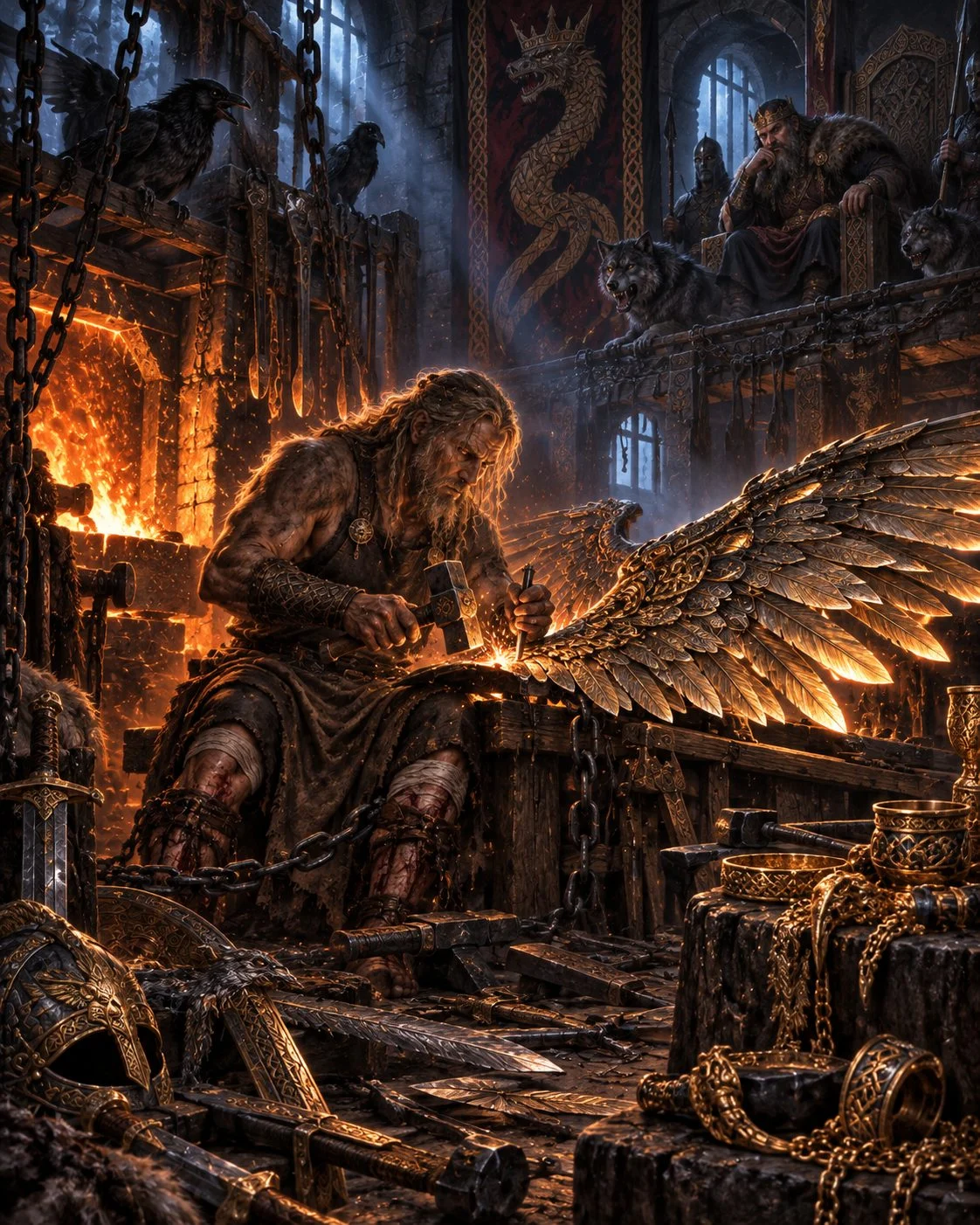
Three brothers lived by hunting in , where they built a house beside a lake. One morning they found three women on the shore, spinning fine flax. Swan-garments lay nearby. The prose introduction calls the women , and gives each a lineage and a name. took as his companion, took Swan-white, and took All-wise.
For years they lived together. Then the women’s longing returned, and at last they flew away toward the dark wood and the battles they were destined to seek. The brothers came home to empty rooms. went east after and south after Swan-white. remained alone. He worked red gold into precious ornaments and threaded rings on bast, waiting in the hope that his bright companion might return.
King heard that the smith was alone. His armed men rode by night, their shields shining beneath a waning moon. They entered the house and examined the hundreds of rings hanging there. They put them back except for one, which they took. returned from hunting, prepared meat at his fire, and counted his treasures. Discovering the missing ring, he thought the woman he loved must have come home and taken it.
He fell asleep with that hope still possible. When he woke, his hands and feet were bound. questioned him about the gold as though it were wealth the smith had stolen from the king. answered by remembering the greater happiness and abundance of the years when his household had been whole. The rings that expressed waiting and craftsmanship were being reclassified as a ruler’s property.
Sat hann svá lengi,
at hann sofnaði,
ok hann vaknaði
viljalauss;He sat so long that he fell asleep, and he awoke deprived of freedom.
kept ’s sword and gave the missing ring to his daughter . The queen watched the prisoner’s eyes and teeth when he saw those possessions in other hands. His look was like a gleaming serpent’s, she said. They should cut the sinews behind his knees and confine him on the island of . There he could make precious things for the king without being free to leave.
The mutilation was carried out. sat at his hammer, sleepless, looking at the work that enriched the man who had crippled him. The sword he had carefully sharpened and hardened now shone at ’s belt. The ring once associated with his absent bride adorned the king’s daughter. He could not walk away from his captivity, but the hands that made wonders remained capable of planning something the royal household did not understand.
’s two young sons came to see the treasures. They wanted the keys to a chest, and the gold and jewels inside held their attention. told them to return the next day, alone. He would give them gold, but they must tell no maid, servant, or person in the hall that they had visited him. The invitation repeated the lure that had first drawn the king’s attention to the smith: extraordinary wealth waiting to be possessed.
The brothers returned eagerly. killed them and hid their remains beneath the workshop’s bellows. From their skulls he made silver-mounted drinking vessels and sent them to . Their eyes became jewels for the queen; their teeth became ornaments for . His craftsmanship transformed the family’s missing children into gifts the family could admire without recognising. The revenge is described with terrible economy, without making the boys responsible for their parents’ crimes.
then broke her ring. Afraid to tell anyone else, she brought it to the smith for repair. He promised to mend it so well that her father, mother, and she herself would find it finer than before. He gave her beer until she fell asleep. The poem later makes clear that he had sex with her and that she could neither resist nor prevent what happened. His vengeance against the king now included an assault on the king’s daughter.
declared that he had avenged his injuries, and rose into the air laughing. left the island weeping, afraid of her father’s anger. The poem does not explain the mechanics of the smith’s flight in the detail supplied by some later stories. It gives the impossible escape as an accomplished fact: the man whose captors had cut his sinews was now beyond their reach above the ground.
, sleepless since the loss of his sons, wanted an answer. What had become of them? Before speaking, demanded oaths that the king would not harm the woman he called his bride or the child she carried. Only then did he tell to visit the workshop. There he would find the boys’ remains. The vessels, jewels, and ornaments already delivered to the household had been made from their bodies.
He completed the revelation with ’s pregnancy. said that no words could cause him greater grief, and none could make him wish the smith more harm. Yet wishing was all he could do. No man was tall enough to pull down; no archer was strong enough to shoot him from where he hovered among the clouds. The king who had converted a craftsman into a captive could no longer reach the man who had destroyed his family.
Hlæjandi
hófsk at lofti,
en ókátr
sat þá eftir.Laughing, rose into the air, while unhappy remained behind.
flew away laughing, leaving in misery. But the poem does not end with the escaping avenger. The king summoned and asked whether what he had heard was true. Had she and been together on the island? Her answer returned the story from triumphant flight to the person who had been left to bear its consequences.
It was true, she said. They had been together for one dreadful hour that should never have happened. She had not known how to resist him; she had not had the power to resist him. Those final words prevent the encounter from becoming a romance or an uncomplicated reward for the smith’s suffering. was grievously wronged, and his revenge grievously wronged others.
ek vætr hánum
vinna kunnak,
ek vætr hánum
vinna máttak.I did not know how to resist him; I had no power to resist him.
The tale began with women able to fly away from a household and a man who waited for his companion’s return. It ends with that man flying away, while another woman must speak from within the household he has ruined. The poem gives us his skill, captivity, and rage in vivid detail, but it gives the last word. Her account remains after the sound of his laughter has gone.
About this retelling
The poem’s prose and verse sometimes differ in small details. This retelling preserves the swan-women opening, the royal children’s victimisation, and Böðvildr’s final testimony. It does not invent the construction of wings or recast her assault as consensual seduction.
The Old Norse follows a normalized edition, rather than the manuscript’s exact spelling. The English beneath each quotation is a new rendering for this reader. Stanza numbers follow the linked Norse text.
Mythological poem 10 / heroic threshold · 1,090 English words · Reading time at 170 words per minute