Gods & the world · 8 min read
The Prophecy of the Seeress
Völuspá
Tap an underlined name for a short explanation.
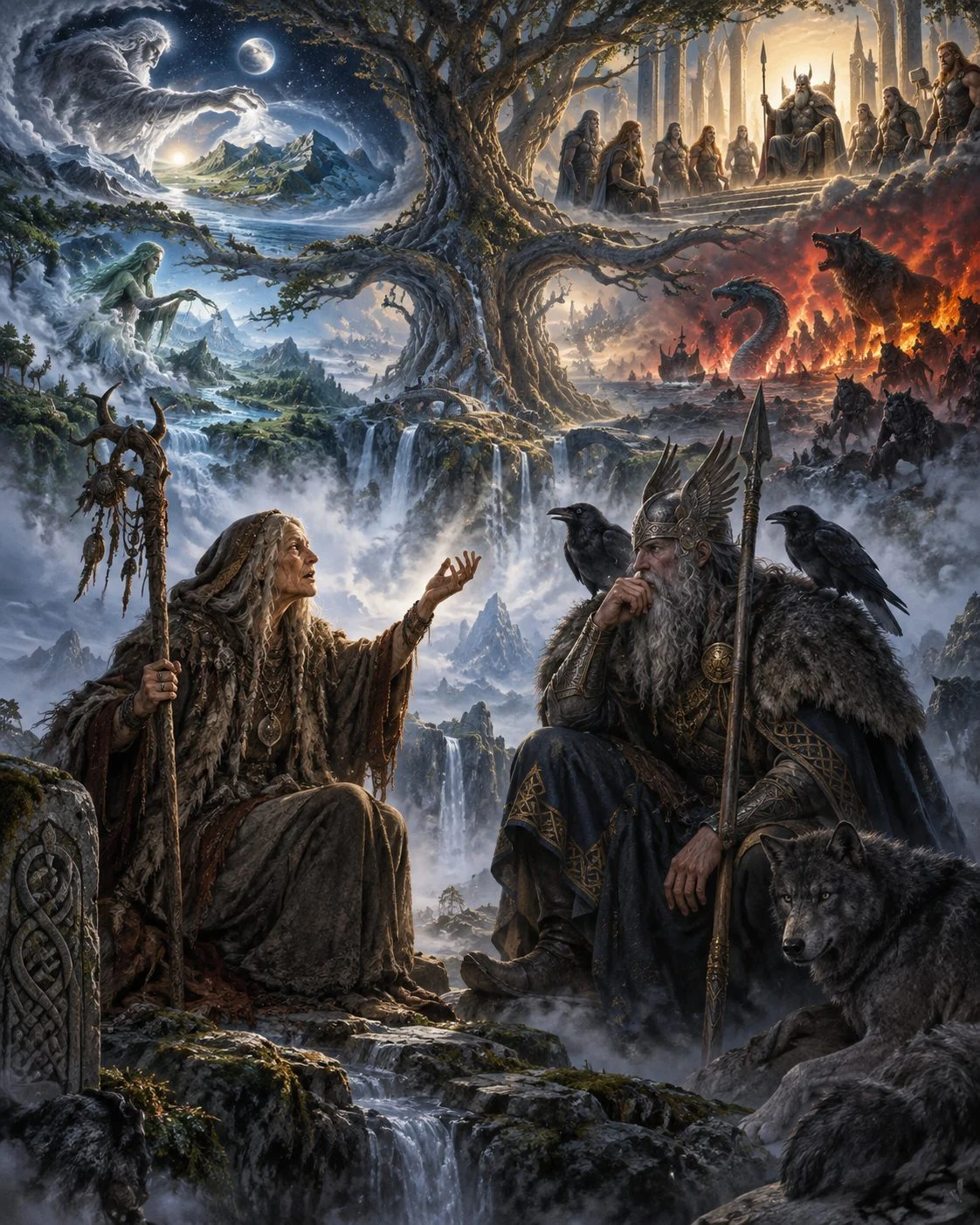
asks for a hearing from a woman who remembers a world older than his own rule. She addresses the great and the small, the children of , and looks past the god before her to the beginnings of everything. The voice is a seeress’s, but its movement is not a tidy history. Memory opens into vision; what has happened and what must happen stand close together. wants knowledge, and she gives it to him without promising comfort.
She remembers the giants who fostered her long ago, and nine worlds beneath the earth. In that first age there was no familiar landscape: no shore to stand on, no cool waves coming in, no heaven raised above a field of grass. Then the sons of lifted the land and shaped the human dwelling of . Sunlight reached the stones from the south, and green growth covered the ground. The sun, moon, and stars did not at first know their places. The gods sat in council and named the divisions of time, making morning, evening, and the reckoning of years intelligible.
At they built high sanctuaries and halls. They established forges, made tongs, and worked metal. In the grass they played with golden gaming pieces, possessing gold without anxiety about its lack. It is a picture of divine abundance that the end of the poem will remember. Yet the first age does not last. Three powerful giant women arrive, and the vision shifts. The poem does not explain every connection; its audience is expected to recognize parts of a much larger store of stories.
Now come the dwarfs, named in a long roll call. and stand at its beginning; many others follow, some with names that suggest directions, objects, powers, or qualities. The catalogue asks the hearer to remember the inhabitants of the world, not merely its rulers. Then three gods find and on the land. They have no settled destiny, no breath or understanding of their own. gives breath, gives understanding, and gives warmth or vital appearance and good colour. Human life begins as a giving of powers.
Above these beginnings stands the ash , nourished by pale moisture, its dew falling into valleys. Beneath it are the women who determine lives. , , and establish laws, choose lives, and set the fates of human beings. Even at the moment when the world seems newly furnished, its inhabitants have limits. The gods can shape land and confer life; the poem does not say that they can simply order fate to disappear.
veit ek standa,
heitir ,
hár baðmr, ausinn
hvíta auri;I know an ash standing, called , a tall tree, sprinkled with pale moisture.
The seeress remembers the first war. is pierced with spears and burned in the ’s hall: three times burned, three times born, still living. A woman called practises powerful magic. The relation between these figures is suggested rather than fully explained. The gods debate responsibility and compensation. casts a spear into a host, the ’s defences break, and the tread the field. In another compressed scene the gods ask who has promised to the giants. rises in anger, and solemn agreements are broken. Divine society has entered the world of violence and damaged oaths.
The seeress can see secrets as well as public disasters. She knows where has hidden his eye, in ’s famous well. She recalls the god coming to her alone and offering rings and necklaces for knowledge. Her recurring question presses him onward: does he want to know more? The answer costs him nothing as simple as money. The knowledge he seeks includes his own destruction, and every new image brings that destruction nearer.
She sees ready to ride. Then , ’s son, stands within the reach of death. A slender mistletoe shoot becomes the weapon will use. A brother born to avenge acts while scarcely a day old, refusing to wash his hands or comb his hair before the killing is answered. weeps in . The poem gives these incidents in swift, hard flashes, rather than recounting all the familiar details supplied elsewhere about the gods’ games or the gathering of promises from every living thing.
A bound figure resembling lies with unhappy beside him. Rivers run through poisoned valleys; a hall far from the sun has doors facing north and walls woven with serpents. There the seeress sees oath-breakers and murderers enduring punishment. In a giant woman breeds wolves. One of their kin will take the heavenly light. The world’s danger is no longer confined to quarrels inside the gods’ assembly: it is gathering in the creatures, halls, and borders around them.
The warning travels through different realms. A red cock crows among the giants, wakes ’s warriors, and another cock cries below the earth. howls before . Bonds strain and break. Among human beings, brothers kill brothers and cousins destroy the obligations of kinship. The seeress names an age of axes and swords, of wind and wolves. The approaching ruin is also a collapse of the relationships that made life within the world possible.
skeggöld, skalmöld,
skildir ro klofnir,
vindöld, vargöld,
áðr veröld steypisk;An axe-age, a sword-age, shields are split; a wind-age, a wolf-age, before the world falls.
raises the . consults ’s head, while the old ash shakes and its branches tremble. advances with his shield; the great serpent churns the sea. The ship is loose, and is associated with the force approaching over the water. comes from the south carrying destructive fire, his sword shining like the sun. Rocks break, beings crowd the road to , and the sky itself is torn apart. The poem moves between armies and landscapes as though the entire world has become one battlefield.
meets the wolf and falls. comes to avenge his father, driving his sword into the monster’s heart in this poem’s telling. , identified as the slayer of , confronts . attacks the world-serpent and kills it, but victory does not save him: he takes nine steps before sinking beneath its venom. These are not defeats caused by a failure to fight bravely. The defenders do what their identities demand, and the world still ends. The sun blackens; the earth sinks into the sea; stars vanish and fire reaches heaven.
Yet the seeress sees the earth rise again, green from the water. Waterfalls run, an eagle flies above them and catches fish beneath the cliffs. At the gods who remain speak of the great serpent and remember the old powers. They find the golden gaming pieces in the grass. The quiet objects of the first age return after the noise of its destruction. Unsown fields bear crops. and are together again, no longer held apart by the killing that defined their former lives.
Sér hon upp koma
öðru sinni
jörð ór ægi
iðjagræna;She sees rising for a second time earth from the sea, ever green.
A hall roofed with gold stands brighter than the sun, offering dwelling and happiness. The vision allows renewal, but its final movement remains unsettling. , the dark dragon, comes flying with corpses upon his wings. The seeress says that now she must sink. She does not explain away this last image or turn her prophecy into an untroubled promise. has heard the making of a world, the breaking of its bonds, and the possibility of another beginning. The voice that showed him all this withdraws, leaving him with knowledge rather than escape.
About this retelling
This retelling follows the Regius narrative, while quotation spelling and stanza numbers follow the normalized edition linked below. The much-debated stanza about a mighty ruler arriving from above is not included: it belongs to the Hauksbók witness, not Codex Regius. The final dragon image is left unresolved.
The Old Norse follows a normalized edition, rather than the manuscript’s exact spelling. The English beneath each quotation is a new rendering for this reader. Stanza numbers follow the linked Norse text.
Mythological poem 1 · 1,250 English words · Reading time at 170 words per minute