Gods & the world · 8 min read
The Sayings of the High One
Hávamál
Tap an underlined name for a short explanation.
The voice at the doorway is a traveller’s. Before crossing a threshold, he says, look around: no one knows where an enemy may be sitting in the hall. But when the traveller becomes a host, the duty changes. A newcomer needs a fire for cold knees, food, dry clothing, water for washing, and a welcome that permits him to speak. The first wisdom of the is made of such exchanges. Survival requires caution, yet a world without hospitality would leave every person stranded.
Gáttir allar,
áðr gangi fram,
um skoðask skyli,
um skyggnast skyli,At every doorway, before going forward, one should look around, one should look carefully.
The advice arrives in clusters rather than as the events of a single adventure. Watch before speaking. Listen to others without imagining that every smile proves friendship. Do not eat so greedily that your appetite becomes the room’s entertainment. Drink with care: ale can steal judgement while seeming to offer pleasure. The foolish man thinks himself safe if he avoids a fight, but age will find him even if spears do not. Another fool lies awake worrying all night and is too tired the next morning to face the troubles that remain.
The speaker distrusts empty confidence. A person may seem wise while remaining silent; once he speaks, his listeners can measure what he knows. Yet silence is not always a refuge either. Someone who never speaks may be unable to defend his place among other people. Wisdom consists in knowing the occasion, not obeying one simple rule without exception. The poem repeatedly places an attractive maxim beside another that complicates it. The traveller must judge which counsel belongs to the hall he has actually entered.
Friendship also requires work. Visit the person you trust, for grass and brush grow over a path that no one walks. Give gifts, exchange thoughts, and answer warmth with warmth. The gift need not be splendid. A small present, given in the right spirit, can secure a welcome. A man with a modest home has something valuable if he can stand as his own master within it. The poem knows the shame of dependence and the loneliness of having no one with whom to share what is in the heart.
Its judgements are practical, sometimes generous, and sometimes harsh. Wealth does not establish wisdom. A person should not mock another’s poverty or assume that disability makes life worthless: the lame can ride, the handless can tend animals, and the deaf can fight. Living still offers possibilities that a funeral pyre cannot. Kin can preserve a name by raising a memorial stone, but even prosperity and family are vulnerable. The herds that fill a rich man’s yard today may be gone tomorrow. Possessions are poor guarantees against change.
Then comes the saying that gathers these counsels into a larger reckoning. Cattle die, relatives die, and the speaker himself must die. What can outlast a person is the judgement others make of the life that has ended. The poem offers no promise that cleverness will abolish mortality. Its concern is how to live among other mortal people, leaving a reputation that will not be wholly at the mercy of the last misfortune. Fame here is attached to conduct, memory, and the stories survivors tell.
Deyr fé,
deyja frændr,
deyr sjalfr it sama,
ek veit einn,
at aldrei deyr:
dómr um dauðan hvern.Cattle die, kinsfolk die, one dies oneself as well. I know one thing that never dies: the judgement of each person who has died.
The voice turns to desire, and its authority becomes less comfortable. Some sayings make sweeping accusations against women. Others admit that men speak beautifully while intending deceit, and that love makes even a wise person foolish. These are not consistent instructions from a disembodied moral judge. The speaker offers himself as evidence. remembers waiting in the reeds for a woman he wanted, imagining that possession of her would be worth more than the wealth and standing of a ruler.
He found ’s woman resting in bed and was told to return later, when their meeting could remain secret. Hope carried him away. When he returned at night, armed people and bright lights blocked his approach. At dawn he tried again, believing the household finally asleep. This time a dog lay tethered in the place where he expected to find the woman. The god who can mislead giants has himself been made ridiculous. His account is resentful, but the incident allows the listener to see a limit to his powers.
Another remembered encounter has a different result and a darker cost. tells of entering the giant ’s dwelling and winning the precious mead associated with poetry. The drill made a passage through stone, and he risked his head among the giants. gave him the drink and helped him escape. His success depended on her trust and affection. The account acknowledges that he repaid her badly, leaving sorrow where he had received aid. When the frost-giants came asking after him, the deed was already beyond their recovery.
The poem questions the trustworthiness of ’s oath. His broken promise stands beside his advice about honest dealings. The same voice knows the necessity of trust and exploits another being’s willingness to offer it. That contradiction remains unresolved.
Now the setting changes to a speaker’s seat and the well of . Counsel is addressed repeatedly to : listen, learn, and benefit. Do not let a wicked person determine your actions. Keep faith with a good friend. Do not take pleasure in another’s misfortune. Be careful about desire for another man’s wife, and about the destructive words that can pass between people. Do not ridicule an old speaker merely because his body has grown frail. Knowledge can remain where strength and beauty have gone.
Much of the counsel returns to the earlier hall. Do not mock a guest or drive away someone in need. The person sitting safely inside may know very little about the stranger outside. These generous passages stand among the poem’s more suspicious sayings.
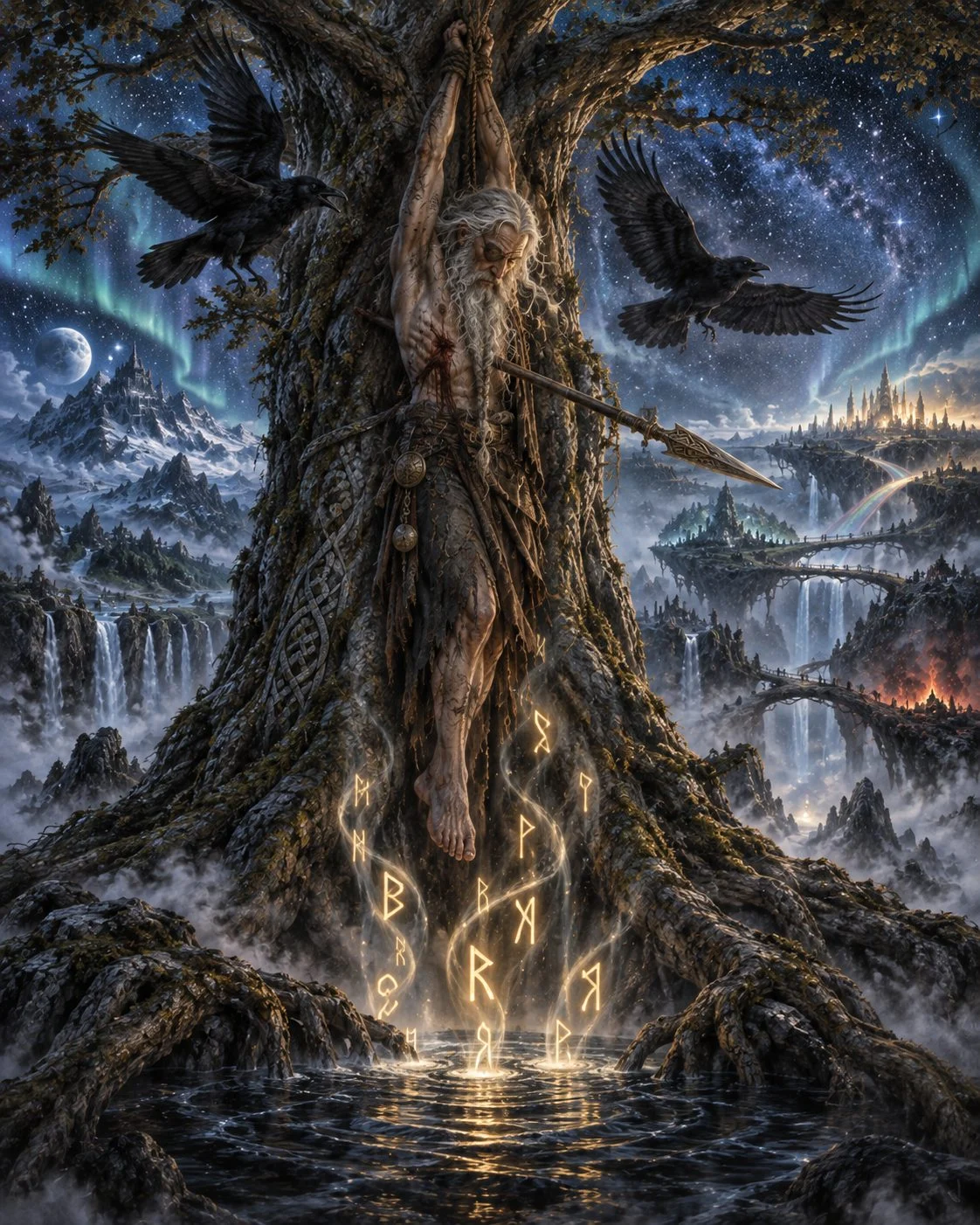
Then ordinary experience opens into ordeal. says that he hung on a wind-beaten tree for nine whole nights, wounded with a spear and given to : himself to himself. He received neither bread nor a drinking horn. Looking downward, he took up the with a cry and fell back from the tree. No named companion rescues him. The knowledge at the centre of the poem is won by exposure, hunger, pain, and an offering in which giver and recipient are the same god.
Veit ek, at ek hekk
vindga meiði á
nætr allar níu,
geiri undaðr
ok gefinn Óðni,
sjalfr sjalfum mér,I know that I hung on a wind-beaten tree for nine whole nights, wounded with a spear and given to , myself to myself.
Afterward his understanding grows. Word leads to word, deed to deed. The poem speaks of powerful songs and a drink of precious mead, then asks whether the hearer knows how to carve, interpret, colour, test, request, sacrifice, send, and destroy. Knowing the shapes of signs is only part of knowing what to do with them. Even offerings require proportion: better not to ask than to demand too much; a gift looks for a return. The old economy of reciprocal obligations reaches into relations with divine powers.
The final movement names songs whose effects extend beyond ordinary counsel. One helps in distress; another concerns healing. Others blunt weapons, loosen fetters, stop a flying shaft, quench a burning hall, reconcile enemies, and calm a dangerous sea. can protect companions going into battle and speak with a hanged man. The list is an account of capacities, not a set of complete spells supplied for the reader to perform. The hearer learns what the knowledge can accomplish without receiving every word that makes it work.
At last reserves a song that he will not disclose freely. The traveller who began at a threshold has carried his listener through friendship, humiliation, betrayal, self-sacrifice, and magic. His changing subjects form the poem’s shape. Even now, he distinguishes what he can teach from what he keeps.
About this retelling
Hávamál is a collection of wisdom, remembered encounters, and magical knowledge, not one continuous adventure. The sequence and tensions between these parts are retained. Quotations use the normalized edition’s numbering; Bellows numbers some stanzas differently. Details supplied only by the Prose Edda, such as the full eagle-flight escape, are not silently added.
The Old Norse follows a normalized edition, rather than the manuscript’s exact spelling. The English beneath each quotation is a new rendering for this reader. Stanza numbers follow the linked Norse text.
Mythological poem 2 · 1,316 English words · Reading time at 170 words per minute