Gods & the world · 8 min read
Freyr’s Love and Skírnir’s Ride
Skírnismál
Tap an underlined name for a short explanation.
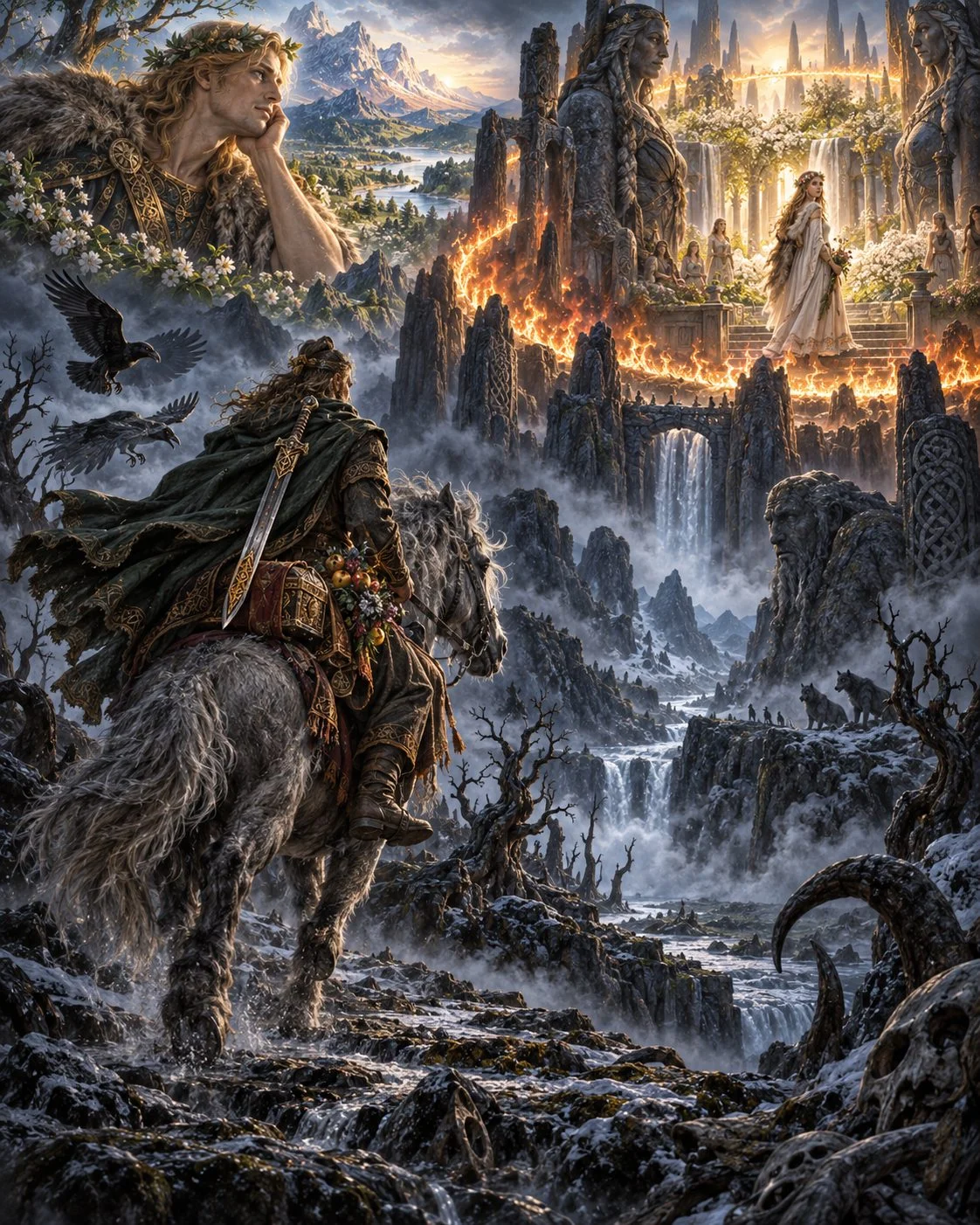
had seen someone he could not forget. Sitting in , the seat from which the worlds could be surveyed, he looked toward the home of . A young woman came from a building and walked into her father’s hall. When she raised her arms, their brightness shone over the air and sea. From that moment withdrew from company. He would neither sleep nor drink, and no one dared ask why.
His household sent to speak with him. The servant expected anger, but he approached the god as someone who had known him since childhood. Why did he sit alone all day? replied that the sun shone every day, yet it no longer shone according to his desire. It would be easier to tell than anyone else, he admitted. In ’s courts he had seen the woman he wanted more than any young man had ever wanted a maiden. He believed neither gods nor elves would favour their union.
Mær er mér tíðari
en manna hveim
ungum í árdaga;The maiden is dearer to me than to any young man in days gone by.
agreed to undertake the journey, but asked for the means to survive it: a horse that could carry him through the surrounding flame, and the sword that fought of itself when its bearer was wise. gave him both. Before setting off, spoke to the horse. Darkness lay ahead. Either they would return together, or the powerful giant would take them both. Desire had made unable to act, and now another person carried that desire into an armed expedition.
At ’s enclosure, fierce dogs guarded the gate. found a herdsman sitting nearby and asked how he might speak with the woman inside. The man answered that he must either be doomed or already dead if he expected to reach her. dismissed the warning. Courage was better than lamentation for a man riding toward his appointed day. The ground shook with his arrival, and asked her servant what made the noise outside their hall.
The servant described a rider who had dismounted and let his horse graze. told her to invite him in and offer the guest good mead, though she feared he might be her brother’s slayer. That fear is left unexplained. Once stood before her, she asked whether he came from the elves, the , or the wise . He denied those identities and announced that he had crossed the fire to seek her company on ’s behalf.
His first offer was eleven golden apples. They would be hers if she consented to love . refused them. She would not sell her affection for gold, and she did not wish to live with ’s son. then offered the remarkable ring that had been burned with ’s young son, the ring from which eight others of equal weight fell every ninth night. She refused that too. ’s house already held enough wealth for her.
With gifts exhausted, the visitor exposed the weapon at his side. Did she see this slender sword? He would cut off her head unless she agreed. answered that she would not submit to any man’s wishes through compulsion. If and her father met, she expected a fight. replied that the same blade could bring the old giant down. The meeting had become a threat against both daughter and household, yet had still given no consent.
Then turned from ordinary violence to a curse. He raised a threatening wand and described the life he could force upon her. She would sit turned away from the world, staring toward the realms of death. Food would become loathsome. She would be made a spectacle, watched and mocked. Longing would torment her without bringing any companionship capable of satisfying it. These were not promises of punishment for some wrong she had done; they were weapons against her refusal.
The threats grew more intimate. She would live with a three-headed giant or have no husband at all. Desire, madness, and unbearable distress would cling to her. called on hostile powers and invoked the anger of the gods. A giant named would possess her below the gates of the dead, where the drink assigned to her would be filth. The wealth she had declined was replaced by a vision of exclusion from ordinary human and divine society.
Finally he spoke of cutting . He would carve a þurs, a giant-, and further signs that bound her to the sufferings he had named. Yet he also held out the possibility of reversal: he could scratch away what he had scratched on. The curse was presented as something conditional, something could escape by giving the answer the messenger demanded. The poem lets that terrible bargain remain audible. Its success does not make the encounter a free exchange between lovers.
svá ek þat af ríst,
sem ek þat á reist,
ef gerask þarfar þess.I can scratch that away as I scratched it on, if there is need for it.
offered a cup of old mead. She said she had never expected to love a . The change in her words followed the curse, not a fresh glimpse of or a sudden declaration of her own desire. would not leave with a gracious drink and an uncertain promise. He wanted to know exactly where and when she would meet his master. A successful embassy required a definite answer.
She named , a quiet grove known to them both. In nine nights she would grant the meeting he desired. With that appointment fixed, rode home. The poem does not follow through those nine nights, describe a wedding, or tell us what became of the weapons after the journey. It turns instead to the man whose unhappiness set the whole expedition in motion.
was waiting outside before had even removed the saddle. He demanded news at once. What had happened among the giants? Had their purpose succeeded? reported the place and the nine-night delay. He did not repeat the detailed threats to the god in this exchange. The reader has heard the whole encounter; hears the promised result.
Nine nights seemed intolerable to him. One night was long, two longer still: how could he endure even three? A month had often felt shorter than a fraction of this waiting night. The poem ends with the lover’s anguish rather than the promised meeting. That ending preserves an uncomfortable difference between the two sides of the story. suffers because he must wait for someone he wants; has been made to choose under threats intended to leave her no tolerable alternative.
Löng er nótt,
langar ro tvær,
hvé of þreyjak þrjár?Long is one night, long are two; how shall I endure three?
The brightness of the woman’s raised arms begins the poem, but her own voice gives its middle section its resistance. She rejects the gold, rejects the ring, and refuses the sword’s demand before the curse finally changes her answer. A retelling that turns into a cheerful matchmaker loses those refusals. Here the road through flame leads to an encounter in which beauty, wealth, divine power, and coercion are inseparable, and the anticipated happiness is left beyond the poem’s last line.
About this retelling
This retelling preserves Gerðr’s refusals and the coercion in Skírnir’s embassy. The poem ends before the meeting at Barri. Its stanza numbering here follows Guðni Jónsson’s Old Norse edition; some translations number the ending differently.
The Old Norse follows a normalized edition, rather than the manuscript’s exact spelling. The English beneath each quotation is a new rendering for this reader. Stanza numbers follow the linked Norse text.
Mythological poem 5 · 1,199 English words · Reading time at 170 words per minute