Heroes & fate · 7 min read
Helgi and Sigrún Again
Helgakviða Hundingsbana II
Tap an underlined name for a short explanation.
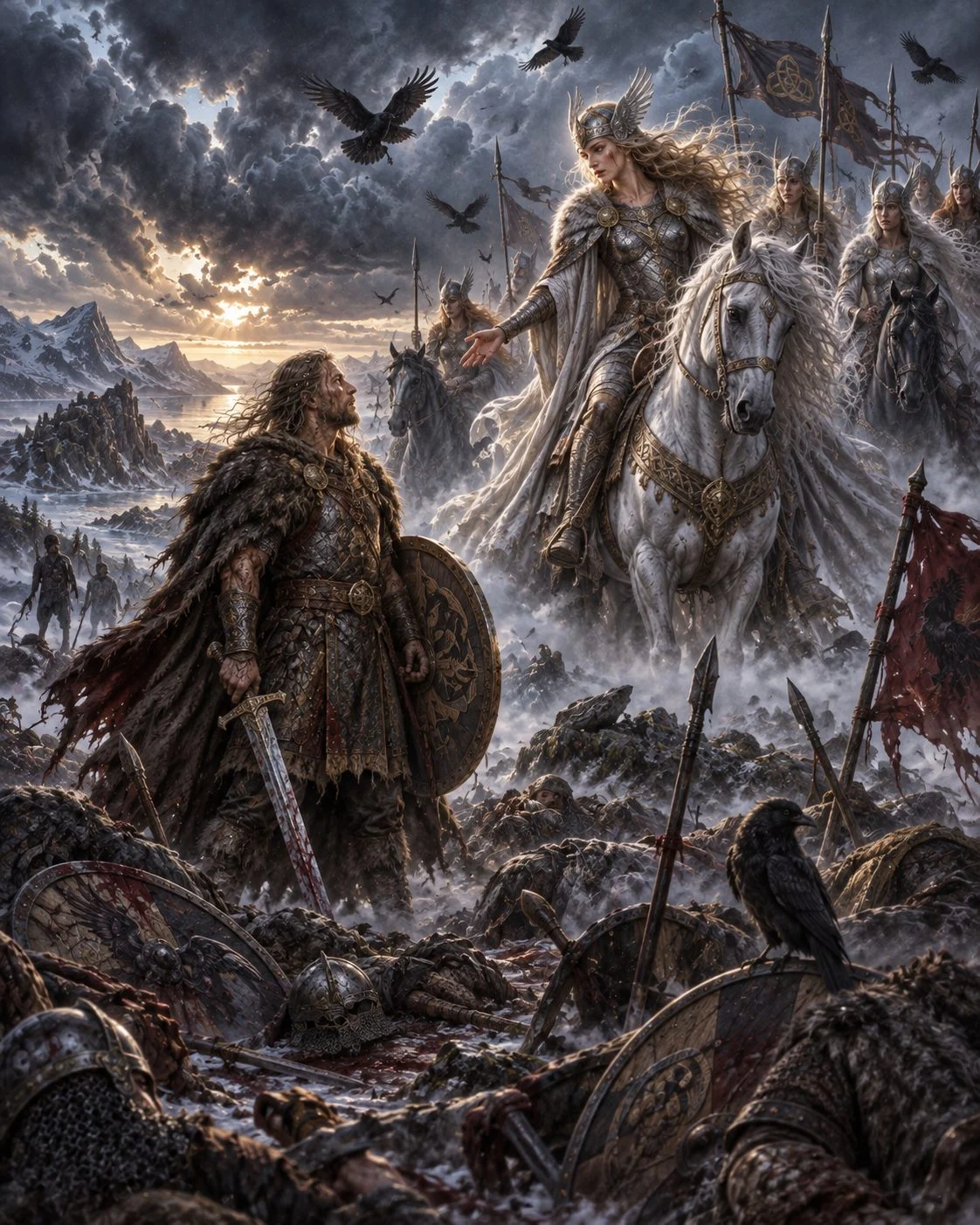
first entered ’s household in disguise. The kings’ families were enemies, and the young man wanted information from inside his opponent’s hall. On leaving, he could not resist sending a message that betrayed who had been there: had sheltered a grey wolf while mistaking him for someone else. Men were sent to find at the home of his foster-father, .
To escape them, he dressed as a serving-woman and turned a hand-mill. His strength nearly betrayed him. The millstones and their supports suffered under his hands, and a suspicious observer remarked on the servant’s fierce eyes. explained that she was a captive king’s daughter, formerly accustomed to riding through the clouds and fighting. The disguise held long enough for to escape to a warship. He later killed and acquired his famous name.
found him with his men by the shore, still bloodstained from fighting and eating meat without cooking it. She questioned him about his identity and his battles. He answered indirectly, but she knew whom she had found. She had seen him in the bloodied bow of a ship and been close to the battle in which fell. Her knowledge defeated his evasions without the threats that had accompanied the earlier search.
Her father had promised her to . She rode over air and sea with the to seek after hearing of the arrangement. Finding him weary from another victory, she embraced him. She said she had loved ’s son before she had seen him, but feared her family’s anger if she refused the husband they had chosen. told her not to fear them. She would live with him.
He gathered a fleet and sailed to confront ’s people. A storm threatened the ships; and the other appeared above them, and the weather eased. The prose account links this arrival to the exchange between and , portions of which are also preserved here. ’s sons raised their allies, including ’s father and brothers. The battle that would free her from one marriage would also place her own kin in ’s path.
won. found dying and told him that he would never hold her in his arms. She sought joyfully, but he answered with the cost of the victory: and her brother had fallen by his hand. Much of her family lay dead. Her brother alone had been spared and sworn loyalty to the victors. wished the dead could live again, provided she could still remain with the man she loved.
She and married and had sons. But ’s oath did not extinguish his desire to avenge their father. He sacrificed to , who lent him a spear. found at and thrust it through him. The husband whose military victories had seemed to settle the conflict was killed by the surviving relative who had sworn to make peace.
rode to tell . He called the death a sorrow he had brought unwillingly upon his kin. She answered by summoning every oath he had sworn to turn against him. His ship should refuse to move even with a following wind; his horse should fail when he needed to flee; his sword should bite only when it struck against himself. She wished him driven into the wild like a wolf, without property or joy, living on corpses.
He called the curse madness and blamed for sowing hostility between relatives. He offered compensation: rings, lands, and half his possessions for and her sons. She refused. No settlement could make her happy while failed to ride home among his men. She remembered how his enemies feared him and how far he rose above other warriors, like an ash above low thorn bushes or a noble stag above other animals.
Svá bar
af hildingum
sem ítrskapaðr
askr af þyrni,So towered above other princes as a splendid ash above thorn bushes.
The manuscript’s assembled account moves between fragments of battle, lament, and the dead hero’s place in . Then it turns to an evening beside his burial mound. One of ’s servants saw approaching with a company of dead men. Was this a dream, she asked, or the end of the gods, or permission for the dead to come home? denied those explanations. The impossible sight remained before her.
The servant hurried back to . The mound was open, had returned, and his wounds were bleeding. entered and greeted him with joy as fierce as a raven’s appetite at the sight of fresh prey. She wanted to kiss him before he removed his bloodied armour. His hair was thick with frost, his body wet with the dew of death, and his hands were cold. What could she do to relieve him?
said her tears fell upon him, each one cold and bloody on his breast. He asked that they drink together and put aside songs of sorrow, though his wounds remained open and life and land were lost to him. The meeting did not restore his body to warmth or health. had come into the place of the dead to hold the man she had lost, and the poem allows their tenderness to exist within that physical strangeness.
She made a bed inside the mound. There he could rest from care, and she would sleep in his arms as she had when he was alive. marvelled that a living king’s daughter would lie embraced by a corpse. For this brief interval, the burial chamber became a household again. The language of bride, bed, and rest survived within earth and bloodstained armour.
Hér hefi ek þér, ,
hvílu görvaHere, , I have made a resting place for you.
But he could not remain. He had to ride the reddened roads of the sky and reach the bridges beyond before the cock woke the warriors. and his company departed, and returned home. The next evening she sent the servant to watch again. At sunset she came herself, hoping that the opening in death might be granted a second time.
He did not return. If ’s son meant to come from ’s halls, said, he would be there already. Eagles were settling on the ash branches and people were going to their dreams. The servant warned her against visiting the house of the dead alone at night. What had happened once could not be summoned by waiting.
Kominn væri nú,
ef koma hygði,
burr
frá sölum Óðins;He would have come by now, if he meant to come— ’s son, from ’s halls.
The prose conclusion says that soon died of grief. It also preserves an old belief that and were born again, while distancing itself from that belief as an old tale. Their later names belonged to another lay, now lost. The surviving poem ends with that unsettled possibility, after giving its fullest scene to a single night when love crossed the threshold of a grave and could not keep the dead from leaving.
About this retelling
The manuscript joins several verse sequences with prose; this retelling follows that assembled narrative without pretending it is one seamless original poem. Stanza references follow the Old Norse edition. The closing rebirth tradition is reported as a belief preserved by the prose writer.
The Old Norse follows a normalized edition, rather than the manuscript’s exact spelling. The English beneath each quotation is a new rendering for this reader. Stanza numbers follow the linked Norse text.
Heroic poem 3 · 1,167 English words · Reading time at 170 words per minute