Heroes & fate · 7 min read
Helgi Kills Hunding
Helgakviða Hundingsbana I
Tap an underlined name for a short explanation.
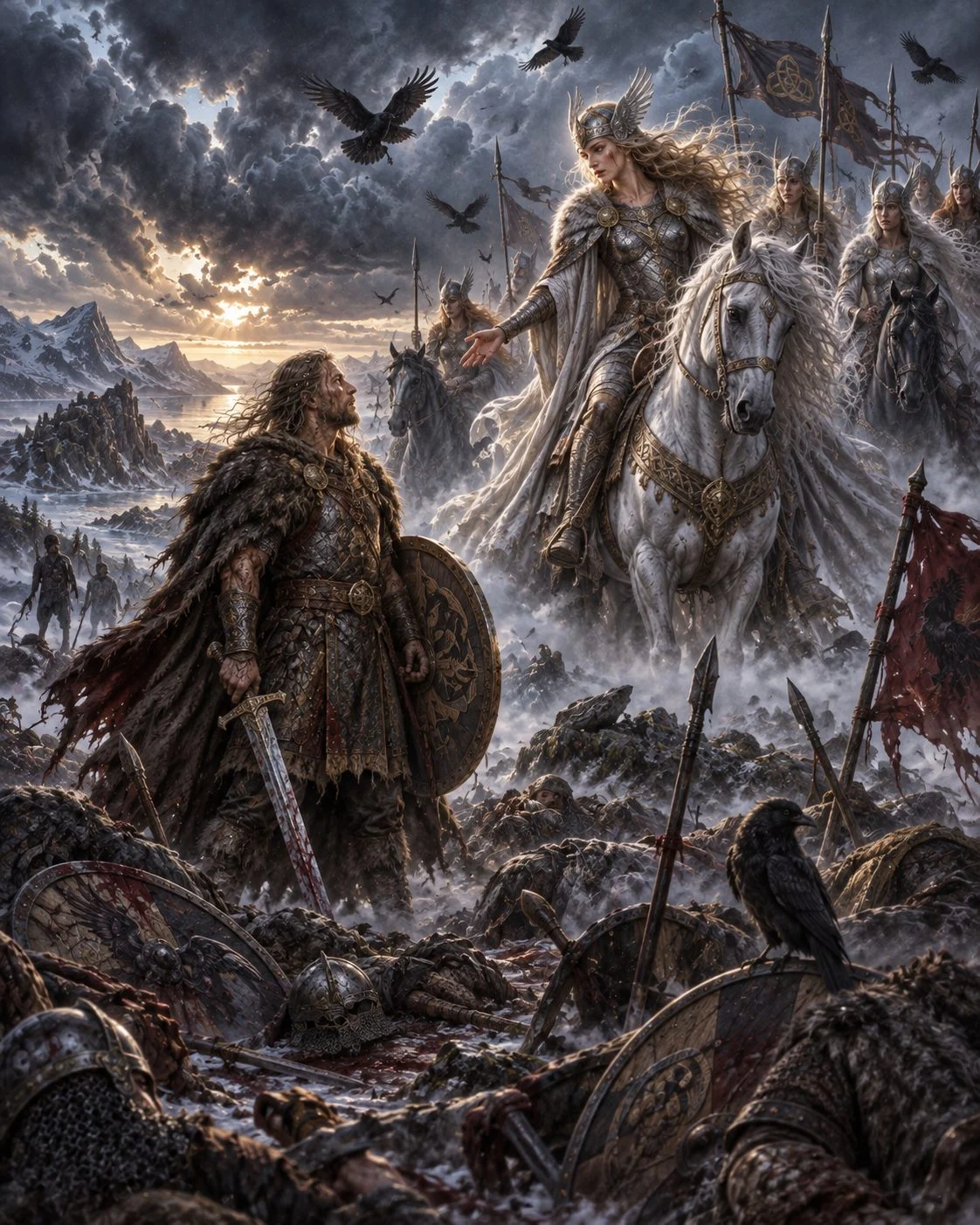
Eagles cried when was born in . Water fell from the heights, and night gathered around the house where had brought ’s son into the world. The came to shape his life. They twisted the threads of his destiny with force, stretched golden strands beneath the moon, and set their ends toward the limits of the land he would possess.
Nótt varð í bæ,
nornir kómu,
þær er öðlingi
aldr of skópu;Night fell over the dwelling; the came, those who shaped the prince’s life.
The child’s future was already being discussed elsewhere. One raven spoke to another from a tree, delighted at the signs of a warrior’s birth. The newborn had the fierce eyes of a fighting man. To people, a great king promised protection and prosperity; to the birds, he promised bodies on a battlefield. Those two expectations enter the poem together and remain together through its celebration of ’s victories.
named him and gave him lands and a splendid sword. The boy grew among his companions, generous with gold and quick to acquire the qualities expected of a ruler. He did not wait long to go to war. At fifteen he killed , a powerful king who had long commanded men and territory. The deed gave the name by which this poem remembers him: , ’s Bane.
’s sons demanded compensation for their father and for the wealth taken from them. refused to pay. Instead of rings, he offered the prospect of a battle, a storm of spears and ’s fury. The armies met, peace gave way, and wolves found food. killed the brothers named in the poem and sat beneath an eagle’s rock after the fighting, victorious but not yet finished with the wars his future contained.
Then light broke over the mountains. Helmeted women appeared, their armour shining and their spears bright. , ’s daughter, was among them. invited the women to stay with him, but had a more urgent purpose than drinking at a victor’s table. Her father had promised her to , a son of , and she did not want the marriage.
She treated the proposed husband with contempt, comparing his royal worth to a cat’s offspring. Yet the arrangement was serious. would come to claim her unless another champion challenged him or took her out of his power. promised that she would not be forced into the union while he remained capable of fighting. Before that could happen, their courage would have to be tested in battle.
Messengers went over land and sea to summon a host. Ships gathered off the coasts named by the poet, filled with warriors, shields, and the wealth needed to sustain an expedition. asked for a count, but his companion described a fleet too numerous to list readily. Additional forces still waited elsewhere. The poem lingers over the assembling ships because the rescue of one woman has become the movement of a king’s full military power.
At dawn the ship-tents came down and the sails rose. Oars beat the water, iron rang, and shield struck shield as the crews worked. The long keels met the waves with a sound like surf breaking cliffs. The sea was not an empty road between battles. ’s daughters, the waves, threatened to drag the vessels beneath them, while waited for the drowned.
ordered the sails lifted higher instead of retreating. Above the fleet, protected its passage. With her help the king’s ship escaped the sea’s grasp and the host reached shelter. She was no longer merely the person for whom the expedition had been raised. As a moving over air and water, she helped bring the armed force safely to its destination.
The arrival was seen from the enemy’s heights. , one of ’s sons, rode to discover who commanded the fleet. answered from the ships, raising a red shield edged with gold. Rather than giving a courteous introduction, he told to carry the news home while tending pigs: the had come from the east, eager for battle, and would find among them.
Their exchange became a long contest of abuse. Each accused the other of degrading transformations, cowardice, sexual humiliation, and monstrous parentage. Some insults drew on stories the poem does not explain; others worked by making the opponent something other than the noble warrior he claimed to be. The charges are weapons in a quarrel, not a dependable biography of either man.
interrupted. would do better to fight and feed the eagles than exchange empty words. did not admire ’s sons, but he insisted that warriors should speak truthfully: those men had shown courage with their swords. The intervention briefly separates his authority from his companion’s verbal excess. He can oppose his enemies without pretending they have never been brave.
þó dugir siklingum
satt at mæla;Yet it befits princes to speak the truth.
carried the warning inland. Riders passed through the landscape toward ’s hall, and the king, already armed, asked why they looked so alarmed. Ships lay along the shore, they told him; an enemy army had arrived. sent his own summons, calling and other allied rulers to the struggle. No man accustomed to weapons should remain seated while this threat approached.
At the armies collided like a storm. fought at the front, hard of heart and unwilling to flee. The helmeted women came from above to guard him as weapons rang around the combatants. The poem does not pause for a duel with elaborate exchanges of blows. It presents the clash as a concentrated surge of blades, kingly courage, and supernatural protection.
spoke over the battlefield. The opponent who had threatened their future was dead. had won both the noble woman and the wealth and lands that accompanied his success. ’s daughter and would be his. Around this proclamation of victory, the wolves and ravens received the feast anticipated at the hero’s birth.
This first lay ends in triumph. It does not continue to ’s murder or ’s meeting with him in the burial mound; those belong to the next account of this pair. Here the golden threads stretched by the seem fulfilled in a ruler’s expanding power and the marriage herself sought. Yet the birds’ view of that fulfilment has never disappeared. The same deeds that make a hero’s fortune leave the ground crowded with the dead.
About this retelling
This lay ends with Helgi’s victory and Sigrún’s praise. Later tragedy is not inserted into its ending. The exchange of insults is identified as hostile speech; place-names are not forced onto a speculative modern map.
The Old Norse follows a normalized edition, rather than the manuscript’s exact spelling. The English beneath each quotation is a new rendering for this reader. Stanza numbers follow the linked Norse text.
Heroic poem 1 · 1,070 English words · Reading time at 170 words per minute