Heroes & fate · 7 min read
Sigurðr and the Dragon
Fáfnismál
Tap an underlined name for a short explanation.
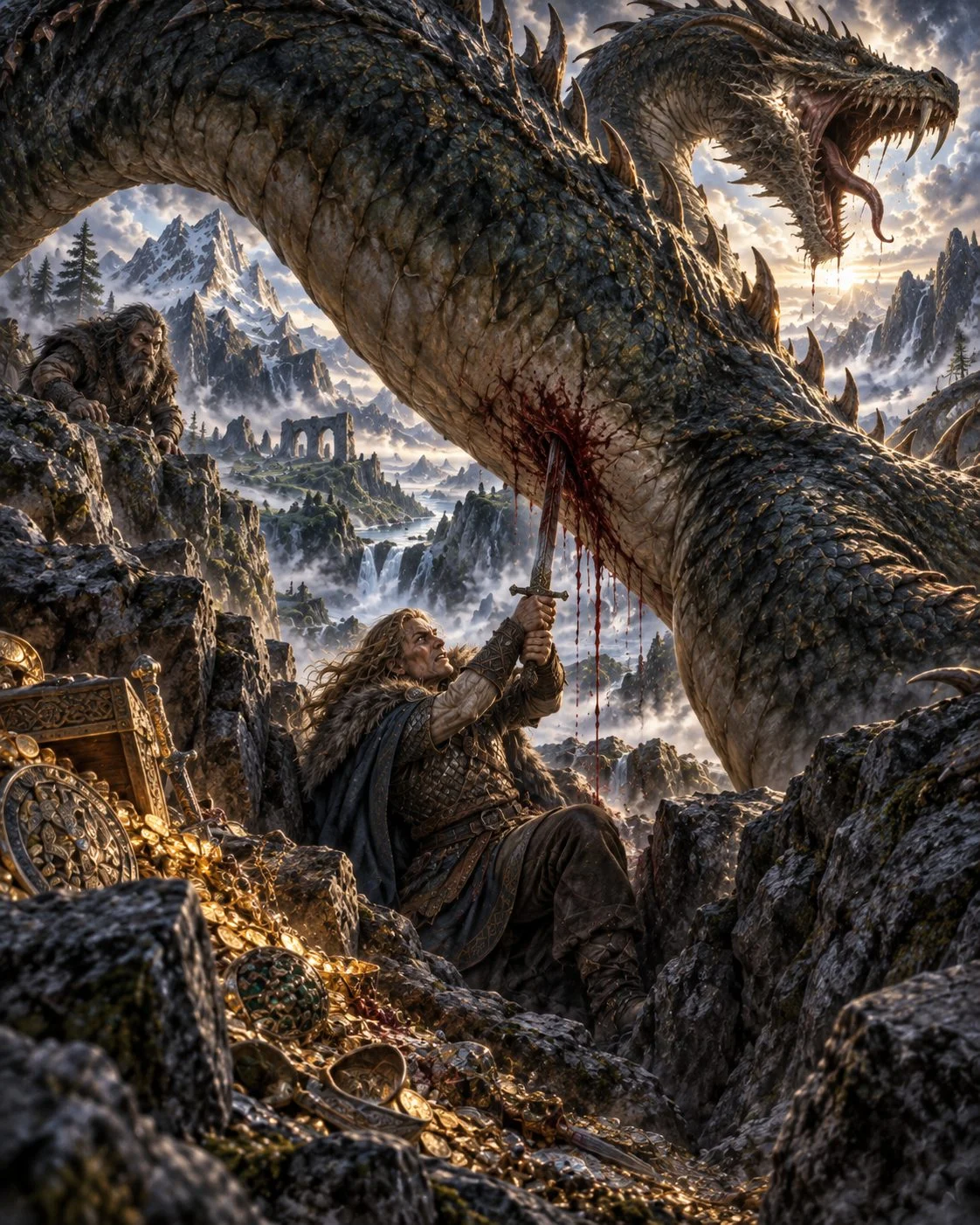
and climbed to and found the track used when he crawled from his treasure to the water. dug a trench across it and waited below the level of the ground. The dragon came down the path breathing venom, which fell over the concealed man. As passed above him, drove into his body toward the heart.
lashed with head and tail. sprang from the trench, and the wounded dragon looked at the man who had struck him. Their encounter became a conversation. wanted his name and parentage. At first answered evasively, claiming to have wandered without parents. The prose explains that he feared a dying enemy might use his name to place a curse upon him.
The dragon challenged the evasion. No man came into the world without parents. then named himself, ’s son, and acknowledged the stroke. asked who had urged him forward. credited his own courage, hands, and sharp sword. The dragon tried to diminish him as a captive far from his inheritance, but the young man insisted that the deed had shown him free.
warned him about the gold. The ringing treasure and red rings would become his death. answered that someone must possess wealth until the appointed day, and every man must eventually depart for . The exchange did not turn the treasure harmless. It showed that its danger was insufficient to make him abandon the victory for which he had risked his life.
Féi ráða
vill fyrða hverr
æ til ins eina dags;Every man wishes to possess wealth until that one final day.
He questioned the dying creature in return. Which helped mothers bring children into the world? answered that the came from different families: some from the gods, some from elves, some from ’s descendants. What was the place where the gods would fight ? The dragon named it and spoke of the bridge breaking when the divine hosts crossed. Even in defeat he possessed knowledge extending far beyond his hoard.
recalled the terror by which he had guarded his wealth. He had thought himself stronger than all others and found no opponent he feared. answered that a fear-helm could not protect its owner against everyone. A man who met many enemies would eventually discover someone stronger. The creature who had seemed invulnerable now had a wound proving the limit of his confidence.
Once more urged him to ride away without the treasure. Once more refused. Then the dragon named the danger nearest at hand: had betrayed his brother and would betray too. They would both be brought to death through him. conceded that the young man had proved the stronger fighter, but his last warning reached past the fight toward the companion who had arranged it.
had kept his distance while faced the dragon. He returned as the victor wiped blood from and praised him as the bravest man alive. resisted that easy judgment: no one could know who was bravest until people were tested together, and courage was not found only in those who reddened swords. then reminded him that he had killed the smith’s brother—and that the smith had contributed to the success.
pointed out where each had been during the danger. He had faced while hid in the heather. answered that without the sword he forged the dragon might still be alive. valued courage above even a good blade. The argument divided a shared achievement into rival claims: the maker of the weapon and the hand that used it were no longer speaking as an uncomplicated teacher and pupil.
Hugr er betri
en sé hjörs megin,Courage is better than the strength of a sword.
cut the heart from ’s body with his sword and drank blood from the wound. He told to roast the heart while he rested. The victor became a servant at a small fire beside the enormous dead creature. When the blood foamed from the heart, touched it with a finger to test whether it was cooked.
He burned himself and put the finger into his mouth. As the dragon’s blood touched his tongue, he understood the birds speaking in the thicket. They saw a bloodstained young man roasting food that would make him wiser if he ate it himself. More urgently, they saw lying nearby, planning to betray the person who trusted him and avenge the brother he had sent him to kill.
Bird after bird pressed the warning. It would be foolish to spare one hostile brother after killing the other. ’s outward words concealed an intention could not safely ignore. The birds advised him to take the smith’s head and become sole possessor of the treasure. ’s accusation had now been repeated by voices could understand only because of the dragon’s blood.
þar er liggr,
er hann ráðinn hefr,There lies , who has plotted against him.
He declared that would not live to tell the story of his death. He cut off the smith’s head, ate ’s heart, and drank the blood of both brothers. The foster-relationship ended beside the brother whose death had been its great shared project. survived the treachery described to him, but the hoard still came to its new owner through another killing.
The birds’ speech turned from immediate danger toward the road ahead. Green paths led to ’s house, where a king had a beautiful daughter. On stood a hall or enclosure associated with flame, and an armoured woman slept there. had punished her with a sleep-thorn after she gave victory contrary to his will. The poem points toward more than one strand of the marriages and encounters that will follow.
traced ’s path back to the treasure’s dwelling. It was dug into the ground, with iron doors, doorposts, and structural timbers. Inside he found a great quantity of gold and filled two chests. He took the terror-helm, a golden coat of mail, the sword , and other precious objects, then loaded everything onto .
The horse refused to move until mounted. Only then could the treasure leave its underground house with its new master. The dragon and the smith lay dead behind him. Ahead were the people and promises the birds had named, and the warning neither victory nor sudden wisdom had erased: the gold could pass from one owner to another without ceasing to carry danger.
About this retelling
This account follows the trench attack, extended death-dialogue, heart-roasting, birds’ warning, and departure with the hoard. The closing birds mention both Gjúki’s daughter and the sleeping woman; these strands are not collapsed into one person.
The Old Norse follows a normalized edition, rather than the manuscript’s exact spelling. The English beneath each quotation is a new rendering for this reader. Stanza numbers follow the linked Norse text.
Heroic poem 6 · 1,077 English words · Reading time at 170 words per minute