Heroes & fate · 6 min read
The Lay of Atli
Atlakviða
Tap an underlined name for a short explanation.
sent to ’s hall with an invitation. The messenger crossed the dark forest and took a seat among men drinking in a room lined with weapons. His words promised a welcome worthy of kings: shields, helmets, horses, scarlet clothing, servants, and rich lands. offered abundance in every form that might tempt a warrior ruler to travel.
turned to . What treasure could offer that they did not already equal? Their halls held swords with golden hilts; their horses, bows, armour, and helmets were among the best. The invitation did not answer an obvious need. considered another message that had arrived with it: had sent them a ring with a wolf’s hair woven into it.
He read the token as a warning. Their road would be wolfish if they went. The men around were reluctant too, but the king answered in the proud, dismissive manner expected of him in the drinking hall. He chose to ride. His decision was not the innocent acceptance of a friendly invitation. The possibility of betrayal had already been named.
As they left, those at home wept. ’s young heir wished the travellers a safe journey. The brothers rode through mountains and toward the land of the , their horses carrying them into the danger the ring had suggested. High walls, watchtowers, and armed men greeted them at ’s dwelling.
saw them enter and immediately warned . He had been betrayed. Why had he not come in armour with a full household of warriors, ready to make himself face the serpents? answered that it was too late to summon the from the . The distance they had confidently crossed could not now be crossed in time by rescuers.
Seinat er nú, systir,
at samna Niflungum;It is too late now, sister, to gather the .
’s men seized and bound him. resisted fiercely, killing seven and throwing an eighth into the fire before he too was overcome. The poem honours the strength of that resistance without suggesting that a handful of fighters could reverse the prepared trap. The king then demanded the treasure as the price of ’s life.
asked for ’s heart to be cut from his breast and placed before him. ’s people first killed the servant and brought his heart on a platter. rejected it. This was the heart of a fearful man, still trembling outside the body, unlike the heart his brother would possess.
They cut out ’s heart while he lived. He laughed and did not weep. When the platter returned, accepted what he saw: the heart lay steady, as it had been steady within . The horrific test had secured the certainty he wanted, and only then did he reveal the purpose behind his demand.
While lived, two men had known the secret of the treasure. Now alone knew it. would never obtain the gold. The could keep the wealth that had passed through gods and heroes; its rings would shine in the water’s depths rather than on hands. Killing the second keeper of the secret had made the first impossible to bargain with.
ordered him taken away. reminded her husband of the oaths he had sworn by sacred powers and objects. He had broken them as surely as her brothers had broken faith with . Her words could pronounce the significance of the deed, but they could not halt the wagon carrying toward death.
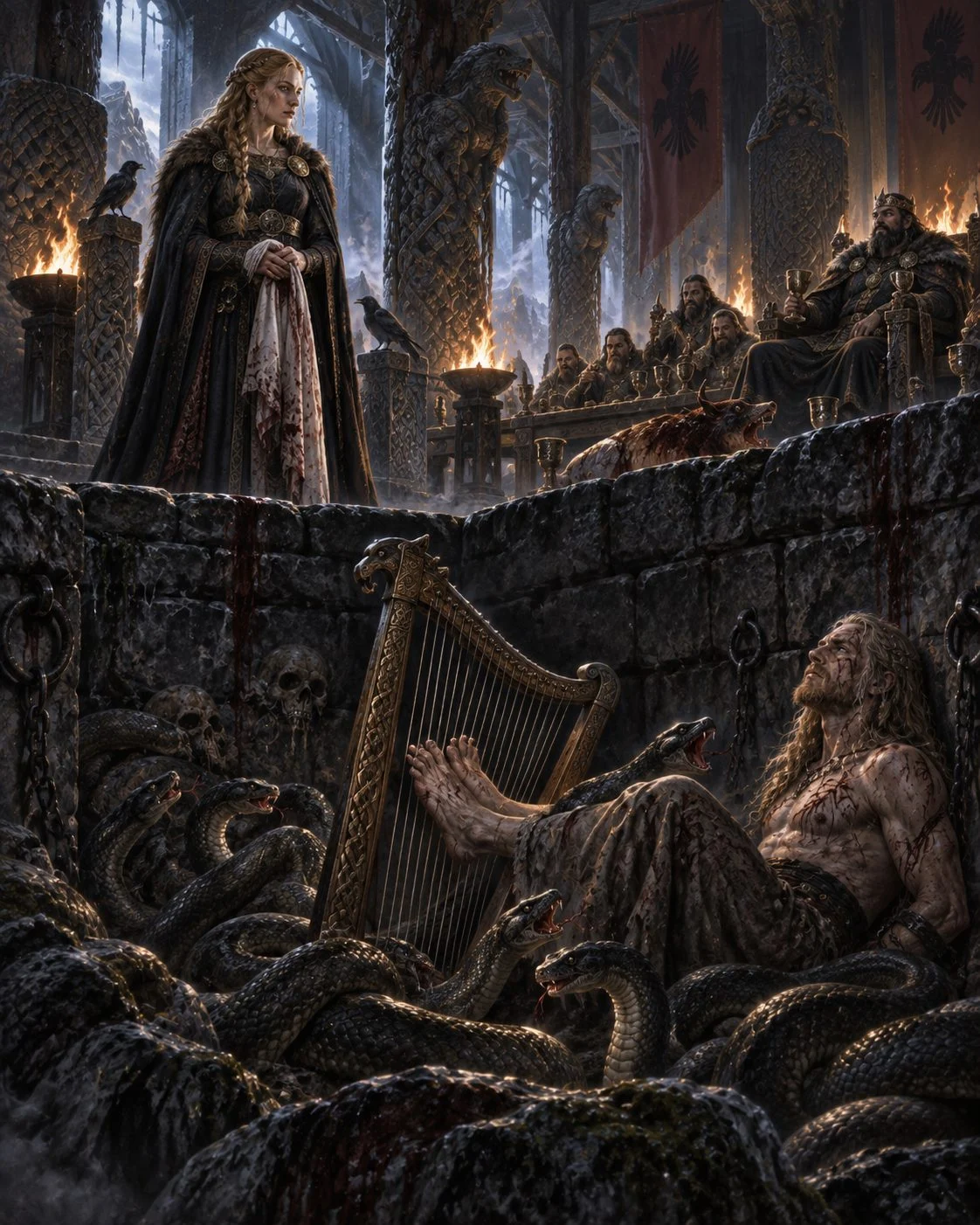
The living king was thrown into an enclosure full of serpents. He struck the harp-strings with his hand, and the music sounded amid the crawling creatures. This poem does not describe him playing with his toes; that detail belongs to the other lay. Here the harp marks the resistance of a man who will protect the treasure’s secret even when protection costs him his life.
rode home from the killing place. Hooves and weapons rang in the courtyard, and came to meet him with a golden cup. She invited him to eat freshly slaughtered young animals. The household assembled for a feast, with loud drinking and the assurance of men who believed their enemies had been removed.
After ate, she told him what she had served. The hearts were those of their sons, and , prepared with honey. He would never again call the boys to his knees or see them at the ordinary tasks of a young nobleman’s life, tending horses and shaping spear shafts. The poem names those lost activities beside the terrible meal, restoring the children’s future just as their mother announces its destruction.
Kallar-a þú síðan
til knéa þinna
né ,Never again will you call to your knees or .
The hall broke into noise and weeping. did not weep for her brothers or the young sons she had borne to . Her revenge had struck the husband through children who were hers as well as his. She distributed gold among the household, allowing the wealth at the centre of so much violence to pass out through her hands.
drank until he was unguarded and without a weapon. gave the bed his blood. Then she released the dogs, roused the household servants, and put fire to the hall. The people who had returned from ’s killing were caught within it. Old timbers fell and the royal dwelling burned with its occupants.
The poem closes by declaring the extraordinary scale of her vengeance. Its language can praise her resolution while the narrative shows the young, the captive, and the dependent destroyed along with kings. No restored family waits outside the flames. fails to gain the treasure, dies keeping its secret, and answers the loss of her brothers by annihilating the household in which she lives.
The invitation had begun with gifts, rich clothing, food, and hospitality. The final welcome uses the same forms: a cup, a meal, and the opening of a hall. What made those gestures trustworthy has been destroyed. The story’s last feast completes the betrayal announced by the wolf’s hair in the first ring.
About this retelling
Atlakviða’s distinctive details are retained: the wolf-hair warning, Hjalli’s substituted heart, the treasure secret, and Gunnarr playing with his hand. The more extensive conversations and toe-playing of Atlamál are left to that separate telling.
The Old Norse follows a normalized edition, rather than the manuscript’s exact spelling. The English beneath each quotation is a new rendering for this reader. Stanza numbers follow the linked Norse text.
Heroic poem 15 · 1,020 English words · Reading time at 170 words per minute